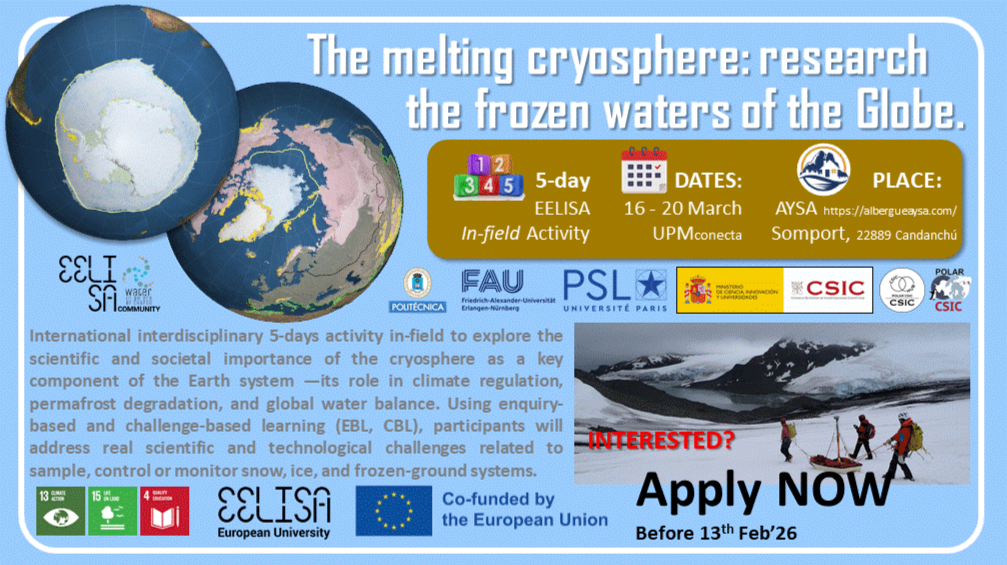
The melting cryosphere: research on the frozen waters of the Globe
This 5-day in-field (Somport, Candanchú, Spain) training activity will immerse early-career researchers and advanced (MSC & PhD) students in the study of the cryosphere as a fundamental component of the Earth system. Addressing SDGs 13, 15, and 4, the activity focuses on the observation, measurement, and interpretation of processes in snow, ice, and permafrost environments, linking field-based geoscientific practice with innovative research and data-driven methodologies. Participants will be drawn from EELISA Alliance, ensuring a balanced representation of educators, learners, and collaborators, including external stakeholders such as Research Institutes from CSIC (Spanish National Research Council), mainly: IGME (Spanish Geological Survey), and IPE (Instituto Pirenaico de Ecología). The activity is embedded within the EELISA Strategic Research Areas of Natural Sciences and Climate, aiming to train the next generation of researchers capable of integrating geophysical, geomorphological, geochemical, and technological perspectives in polar and alpine contexts.
The teaching staff will consist of EELISA partners with expertise in cryospheric science and Earth observation: UPM, PSL, FAU and associate partner Polar Hub of CSIC.
The activity employs a combination of Challenge-Based Learning (CBL) and Enquiry-Based Learning (EBL) within a collaborative, co-creative framework:
(i) Challenge-Based Learning: Participants will address a unifying challenge: “How can we characterise and monitor the physical and biogeochemical properties of the cryosphere to better anticipate its response to climate change?” This overarching question will guide all daily sessions and group work, fostering creative problem-solving and cross-disciplinary teamwork.
(ii) Enquiry-Based Learning: Learners will formulate research questions, plan observational strategies, and analyse real datasets using open-source tools, replicating the scientific research.
(iii) Collaborative and co-creative methods: Teams will be composed of mixed backgrounds (geophysics, engineering, environmental sciences, data science) and mentored by educators from different EELISA partners. Peer-to-peer learning, shared reflection, and synthesis will ensure a participatory and inclusive dynamic.
(iv) Digital tools (shared virtual lab notebooks, cloud-based data analysis, online debriefings) will facilitate hybrid participation, enabling students unable to attend in person to engage synchronously and asynchronously in all activities.
The consortium will include EELISA partners with expertise in cryospheric science and Earth observation (e.g., UPM, PSL, FAU and associate partner Polar Hub of CSIC). The planned activities will cover the following topics: 1: Setting the Challenge, 2: Safety & Logistics, 3: Observing the Cryosphere and 4: Innovation & Data Integration.
Selection of participants will prioritise diversity of disciplinary backgrounds and institutional affiliation to strengthen the EELISA Alliance’s transnational and interdisciplinary character. Participant performance will be evaluated through a rubric which considers: (2) Team-based challenge report (design of an observational/monitoring proposal), and (2) Individual reflective logbook documenting learning progress and teamwork contribution.
The overall workload is estimated at 2 ECTS (equivalent to approximately 50–60 hours of learning, including preparatory readings and post-activity reporting). Upon completion, participants will receive an EELISA Credential recognising: the interdisciplinary knowledge acquired in cryospheric science and climate monitoring, the collaborative and innovative competences developed (aligned with Impact Level 4 – Action: application and integration of Knowledge) and the contribution to SDGs 13, 15 and 4 through research and education.
Credentials will be jointly issued by the participating EELISA institutions and uploaded to the EELISA digital platform for traceable recognition.
WHEN
16 to 20 March, 2026
WHERE
Onsite at Candanchú: depart from the School of Mines and Energy (Madrid) by bus to Candanchú. Friday 20th afternoon, bus will depart back to Madrid
APPLICATION DEADLINE
13/02/2026