

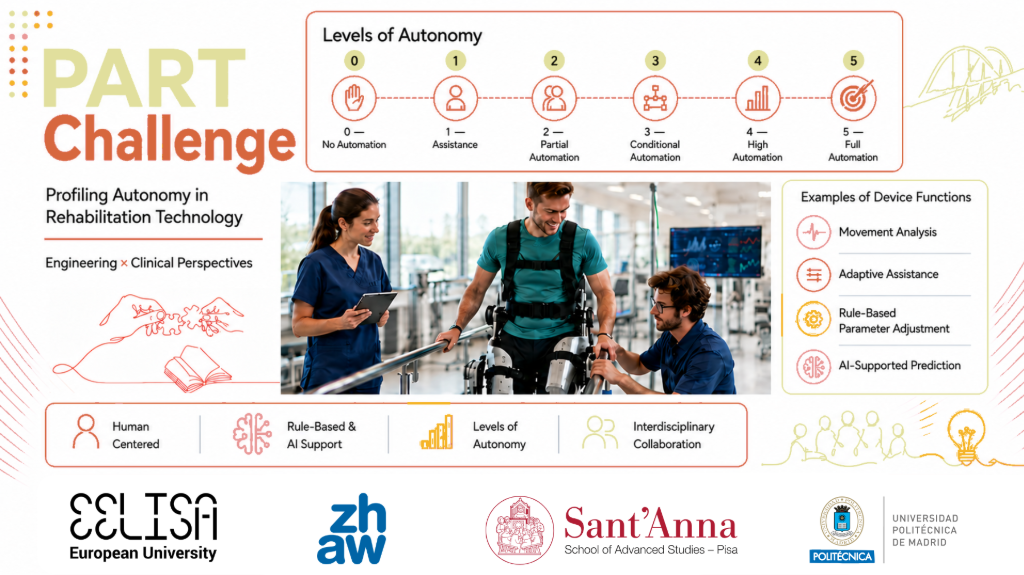
The PART (Profiling Autonomy in Rehabilitation Technology) Challenge
The PART (Profiling Autonomy in Rehabilitation Technology) challenge is an interdisciplinary initiative designed to redefine how we understand human-machine interaction in clinical settings. In many domains, technology becomes increasingly autonomous. In autonomous driving, the car engineering society has come up with a unified classification of levels of driving autonomy, that applies to all cars and to all driving functions. Although similar terminology could be helpful for medical technology, proper definitions are more complicated through the many functions medical devices perform.
Autonomy must likely be defined in specific ways for any specific form of application of the device. Aligned with the EELISA Community AI4Health mission, this project seeks to bridge the gap between engineering theory and clinical reality by focusing on functional autonomy.
Following a Challenge-Based Learning (CBL) methodology, interdisciplinary student teams (PhD and MSc students) will perform a functional deconstruction of rehabilitation technologies. Rather than evaluating a device as a whole, students will identify its core clinical functions, such as adjustment of training parameters or selection of training goals, and conduct a structured thought experiment. They will elaborate on how these functions may be implemented with different levels of autonomy. Through this process, students will identify where the device would be operated by the therapist, would be following simple rules, and where it would be using AI, to perform the specific functions.
Supported by industry experts and the ZHAW Rehabilitation Technology MOOC, the activity will generate reusable educational frameworks and “Autonomy Profiles” that support safer, more transparent clinical innovation.
You will
– get access to a MOOC about Rehabilitation Technology to study and prepare at your own pace,
– join a synchronous online lecture about the autonomy of devices and
– participate in a two-day (on-site or online) group session where you theoretically take a specific rehab technology apart in its functions to analyse them in regard to their autonomy in an interprofessional team.
Enrollment Conditions
Participation is open to MSc and PhD students from EELISA universities, especially students with backgrounds in engineering, rehabilitation technology, health sciences, or related fields.
The challenge is limited to 42 participants in total: 21 on-site participants and 21 online participants. We aim for a balanced cohort, with approximately equal representation of students from technical disciplines and health professions. If applications exceed the available places, participants will be selected based on disciplinary balance, study level, representation across EELISA universities, and motivation to participate.
Participation
Participation is free for students within EELISA.
For on-site participants, travel and accommodation costs for non-ZHAW students may be covered partially. Participants are expected to complete the preparatory MOOC, attend the synchronous online lecture, which will take place approx. two weeks before the workshop, and take part in the two-day group session (27 to 28 Mau 2027) either on-site or online.
WHEN
27 to 28 May 2027
WHERE
Online and Onsite in Winterthur (Switzerland)
APPLICATION
Application is open via Digital Campus until 31 October, 2026