

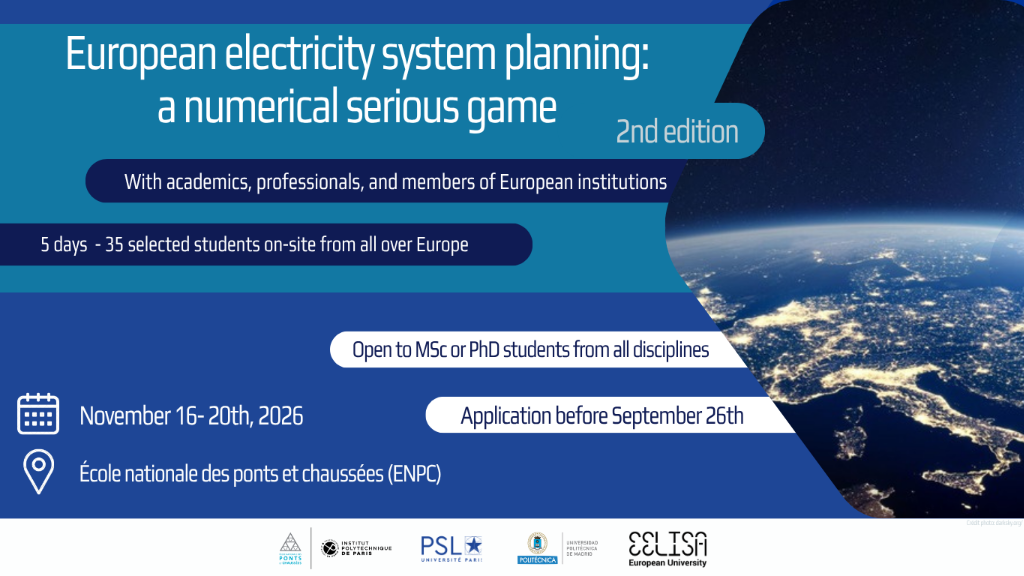
European electricity system planning (2050) as a serious game
This activity is designed as a pluri-disciplinary teamwork experience around the challenge of building a resilient, efficient and carbon neutral European electricity system for the upcoming decades. This 5-day activity will feature classes given by several experts from academia, industry and European institutions, and a large amount of time will be dedicated to supervised practical sessions taking the form of a serious game based on numerical simulations of the possible futures for the European electricity system. These simulations will be done on a PyPSA-based dedicated environment, using European Resource Adequacy Assessment data.
The aim of this activity is to introduce students to the questions, concepts, models, mathematical and computing tools related to electricity systems planning. The students will play a serious game focusing on the European system, in which they will act out the associated collective decision-making process. Each team of students will be responsible for making the investment decisions in one country: which power capacity for electricity production units in 2035-50? Which network interconnection capacities – allowing to mutualize the “efforts” with their neighbors?
Through the theoretical sessions, students will be given the main concepts and models underlying this work: how to define different scenarios for future electricity demand depending on the specificities of their country? How can the challenge of satisfying electricity demand at minimum cost be cast as a mathematical optimisation problem (Unit Commitment, or UC)? How to find a “good” tradeoff between the level of description of the many techno-economic constraints and the induced complexity on the obtained optimisation problem? How could/should climate change be accounted for in such a planning problem?
Dedicated to both numerical practice and to discussions and negotiations played by participants, students will be able to implement their national strategic investment decisions, simulate the European system and finally, measure, discuss and improve, with other countries simulated by other teams, the global operational behavior of this collective system, even under numerical “stress tests” designed to highlight the difficulties the system will face in upcoming years.
To go further
– A more detailed description of this course can be found here.
– “European Resource Adequacy Assessment”, an example of public study to plan the future of an electricity system. See 2024 edition main page, and download its Executive report if you are very curious!
– In the case of France, see RTE (France’s “Transmission System Operator”) ”Energy pathways 2050” to get a typical idea of the projection of a “system” to 2050… if you have dozens of engineers * years of work available! Idem, you can find the Executive summary here.
– Regarding the fundamental technico-economic and mathematical concepts associated with this summer school, the following Wikipedia page provides the foundations of the Unit Commitment Problem.
Credentials
Through this activity, all participants will receive EELISA credentials for achieving Level 3 in SDGs 7, 13, and 17. Additionally, students will write position papers or posters.
Participation and traveling
– Registration and participation are FREE
– A dedicated Joint Call budget is available to cover travel costs to Paris and accommodation costs for a selection of students from institutions outside Paris/Île-de-France. Students who are not covered by this funding are encouraged to contact the EELISA coordinator at their institution to explore alternative support options.
WHEN
From 16 to 20 November, 2026
WHERE
Onsite at Champ sur Marne (Paris)
APPLICATION DEADLINE
20 September 2026