

Global challenges are no longer abstract. Climate change, renewable energy transitions, smart cities, sustainable infrastructure and digital transformation are reshaping societies at an unprecedented pace. In this global race, Europe is competing with regions such as Asia and the United States—not only for technological leadership, but for talent.
Europe’s ambitions are high. Yet one major challenge stands in the way: the growing skills gap in engineering. Not only are more engineers needed than ever before, but the profession itself is changing rapidly. Engineers today are expected to master new technologies, think critically, and collaborate across disciplines and borders.
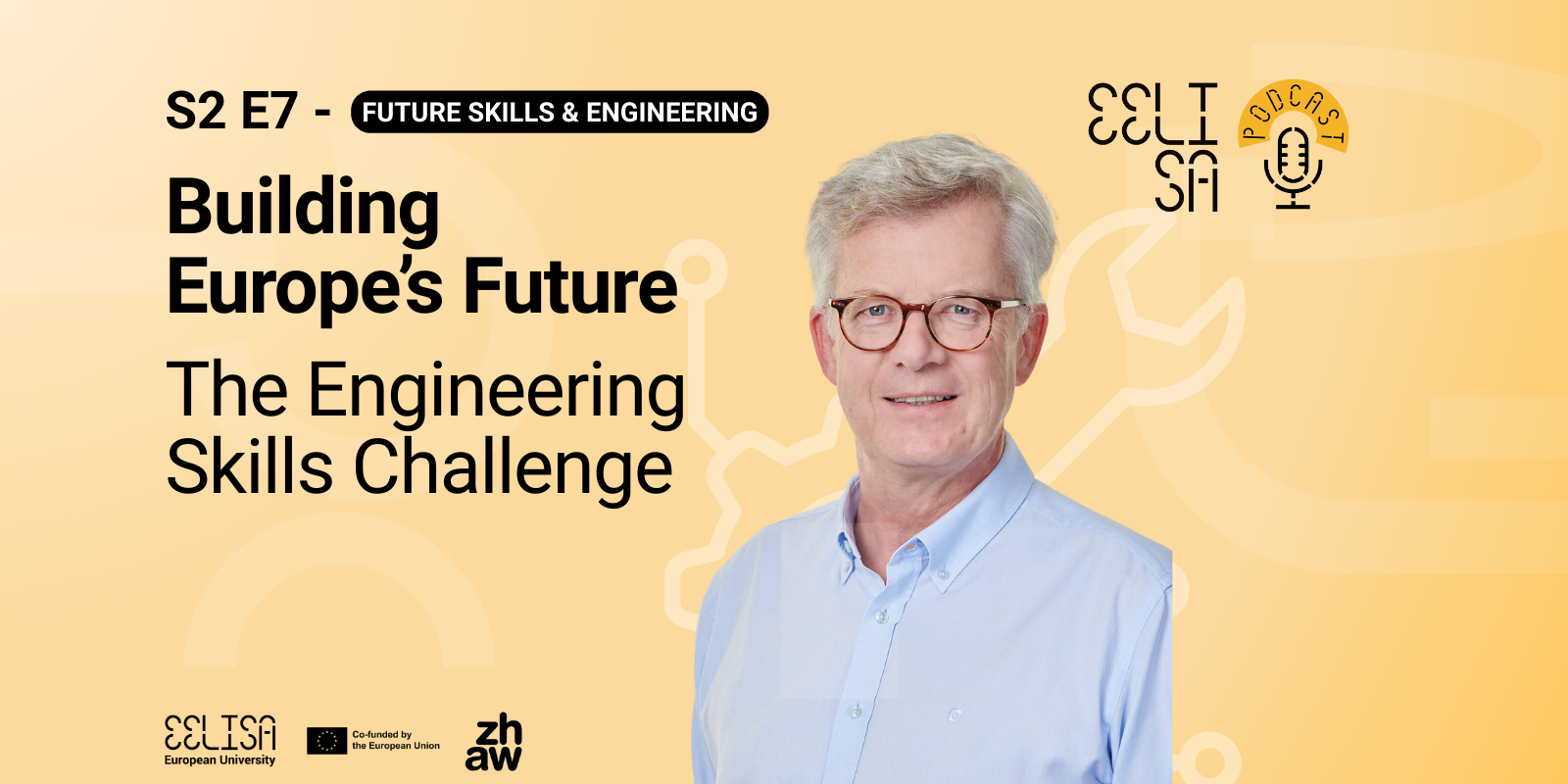
To tackle this topic, EELISA communication Representative Jamuna Siehler talks with Hannes Treyer, member of the Swiss National Committee of Engineers Europe and te World Federation of Engineering Organizations.
What are the skills needed for the future of engineering?
While technical skills are always a must, the advances of new technologies such as AI have impacted the engineering landscape. In such a context, Hannes Treier points out the importance of developing a critical thinking:
Today, artificial intelligence does a lot of work for you, but you have to be able to qualify it, to validate it.You have to distinguish between what you think is really good, also with the help of artificial intelligence, and you have to recognize where it might, where it requires improvements, a rework, and that’s definitely a new competence.
The imporance of going abroad
Critical thinking is not the only skill today’s engineers need to develop. As global challenges grow increasingly complex, he highlights the importance of multidisciplinarity and the ability to work effectively in multicultural environments. In this context, international mobility plays a key role. As he explains:
I think very much that working abroad or studying abroad for a certain time is very valuable because it’s a different thing if you spend holidays in Sweden or Spain or in France. Or if you, for a certain time, study or work in a different culture, I think it’s very, very valuable. You improve your language, you develop an understanding of a different culture. So I would encourage everybody to do such a student exchange program.
Industry’s role in closing the skills gap
Universities play a central role in engineering education and in developing the skills future engineers need. However, companies frequently point to a gap between their expectations and the actual skills of recent graduates, but how can this be addressed? Hannes offers a clear perspective.
When employers, companies complain that the young students, young engineers do not have the qualifications, it might be also on them to provide an internship, to have upscaling within the company. They also can contribute towards to have the right workforce.
Hannes Treier
He is an engineer with extensive experience at both national and international levels. He is a member of the Swiss National Committee of Engineers Europe and the World Federation of Engineering Organizations, and serves on the advisory board of Engineers Day in Switzerland.