
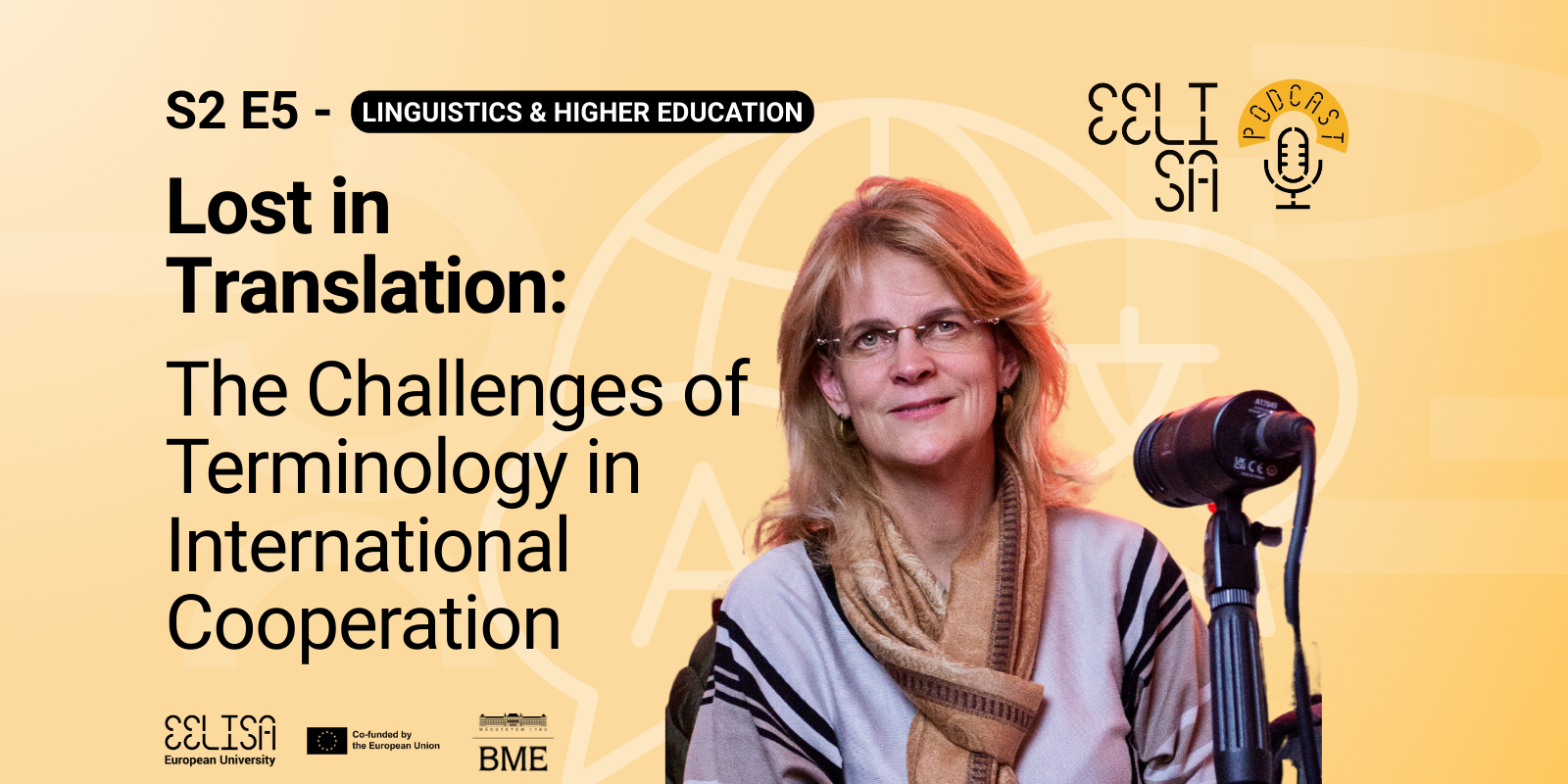
What happens when you use the right word in your language, but it loses its meaning in translation? Explore a topic that hides in plain sight: terminology in international academia. What seems like a simple matter of vocabulary can actually lead to miscommunication, misalignment, and even safety risks.
In this new episode, hosts Viktor Hankó and Mark Kovacs are joined by Márta Fischer, head of BME’s Center for Modern Languages, to explore why shared words don’t always lead to shared understanding, and why universities must address this challenge with urgent attention.
English as a “common” language
Even if we use a shared lenguage, like English, we must be aware that we are not speaking the same “English”.
“Behind the same term, we may have various concepts due to the fact that we come from different countries. Each country has its own conceptual and legal system.”
While English functions as a common working language, it is far from uniform. Different countries, institutions, and disciplines map different concepts onto the same terms. As Márta Fischer explains, “we speak different kinds of English,” as shared terminology often masks different conceptual systems.
The risks of miscommunication
Although it may look like a minor linguistic detail, Terminology shapes everything, from international collaboration, to student mobility and even safety. As Márta Fischer Illustrates the tragic 1977 Tenerife aviation disaster, where over 600 lives were lost due misscomunication over the term “takeoff”.
You may think it is only a linguistic problem, but it is not. Terminology goes beyond linguistic issues because you need to look beyond and detect the concept behind.”
As she explains, emphasizing that clear definitions of concepts must come before communication to prevent catastrophic misunderstandings.
Márta Fischer
Head of BME’s Center for Modern Languages