
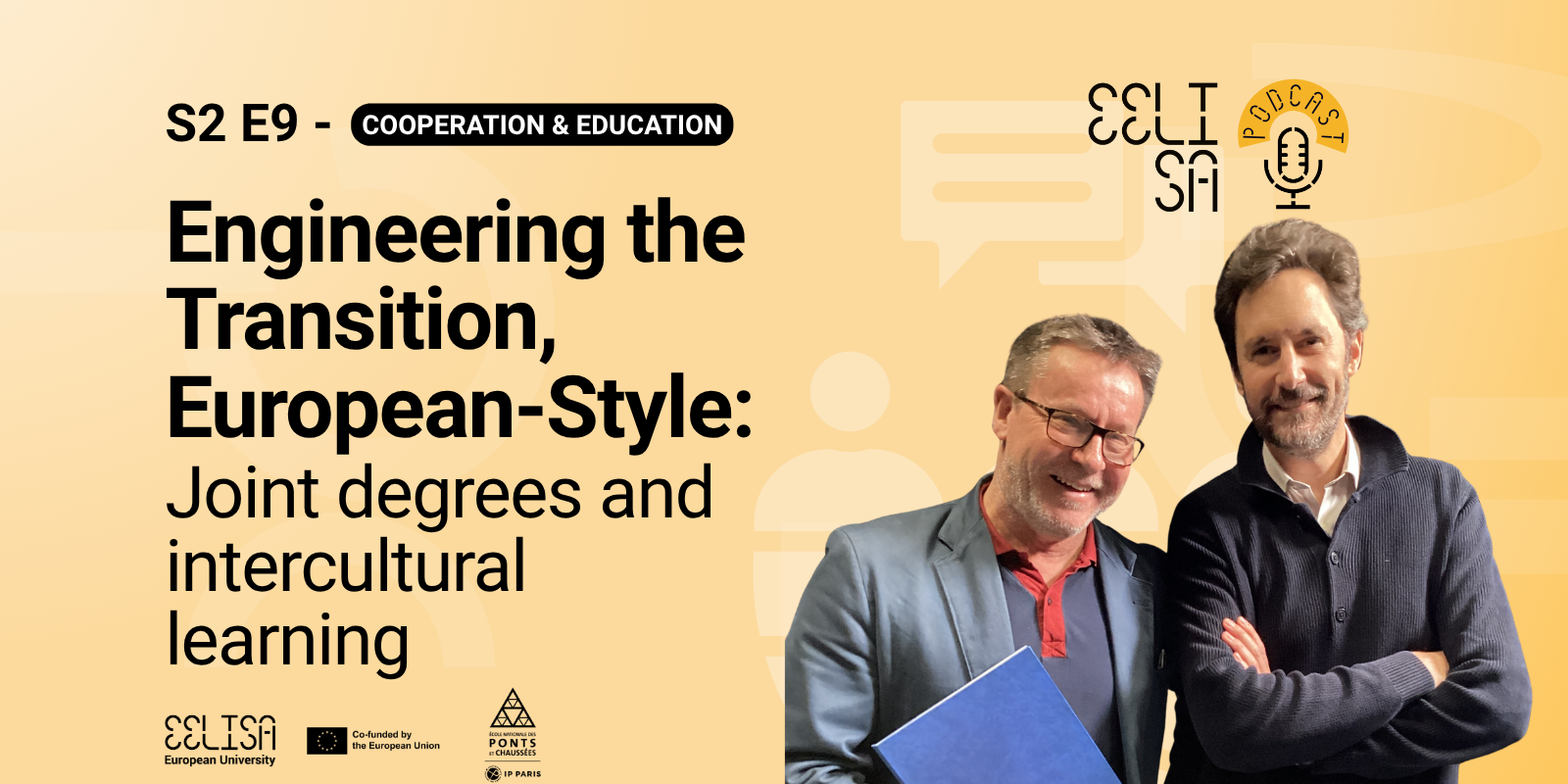
In a time marked by climate uncertainty, complex infrastructure systems, and increasingly interconnected societies, how should Europe educate its future engineers? As navigating complexity becomes ever more essential, the ninth episode of the second season of the EELISA podcast explores what it truly means to “engineer the transition” within a European context.
To explore the future of possibilities, ENPC’s Communication Representative, Habiba Touil, welcomes two guests from the École nationale des ponts et chaussées: Thibaut Skrzypek, who works on joint education and recognition within EELISA, and Steve Brown, President of the Department of Languages and Cultures.
Universities & the ecological transition: what are we really training for?
Transitions aren’t only technical — they’re human. So there’s a growing awareness that the humanities have an integral part to play in engineering education. Engineers will work across borders and cultures. So we have to give them a toolkit to help them adapt, observe, and listen better.
Why joint degrees matter for Europe
Jount Degrees are the result of a coordinated effort between different Higher Education institutions, which provide the field for students to increase specialization, international experience, and develop unique, multidisciplinary profiles.
oint degrees allow universities to build programmes around shared curricula, learning outcomes, and academic responsibility. In this sense, they can help structure a more integrated European education ecosystem.
Joint degrees are a way to build a true European education ecosystem — not only through mobility, but through joint curricula, joint learning outcomes, joint values, and joint quality assurance.
Such initiatives, he explains, can develop in different ways: through highly integrated flagship programmes built collaboratively from the start, or by progressively embedding European components into existing degrees, enabling more students to benefit from cross-border learning. From a ultural perspective, these initiatives also have an impact on the student’s perspective. Steve Brown believes that Joint Degrees are aan enriching way to discover how different cultures approach engineering disciplines.
It’s learning in more than one academic culture, getting access to different ways of thinking, debating, and working (…) students have to be prepared to open up, to become receptive, to the Other, and host students also have to be receptive to the “outsiders”.
Educating engineers for the transition requires more than technical excellence. It calls for European cooperation, shared educational pathways, and the ability to work across cultures and disciplines. Joint degrees and collaborative initiatives between universities offer a concrete way to build this common space — one where students can learn within multiple academic traditions while addressing shared societal challenges
Thibaut Skrzypek
He is an International Cooperation manager at the École nationale des ponts et chaussées (ENPC), where he develops academic partnerships and supports the design and implementation of international higher education programmes. He is also Work Package Leader and Staff reprensentative within EELISA European University, contributing to the alliance’s strategic development in joint education initiatives. A civil engineer and French public servant at the Ministry of Ecological Transition, he brings long-standing expertise in programme development.

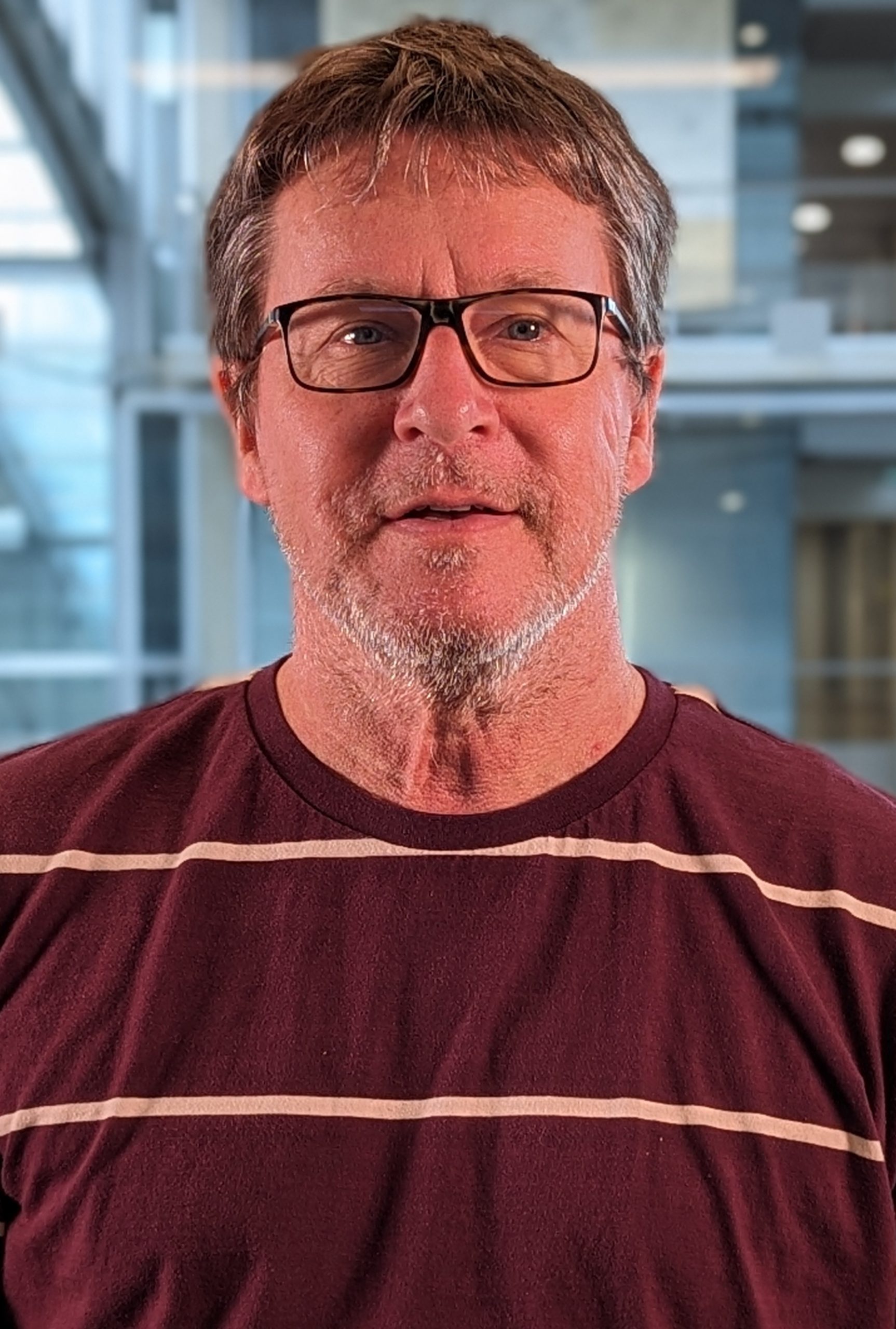
Steve Brown
He is President of the Language and Culture department at ENPC. Ten different foreign languages are taught at Ponts, including French for our international students, and all students study two languages, including English, for the whole of their programme. Steve has been involved in various international initiatives – a formal exchange programme between another engineering school and Cambridge Engineering, outreach programmes around the theme of ecodevelopment, and was a founder member of the Alliance for Climate Action Now at the Université Paris-Saclay. .