
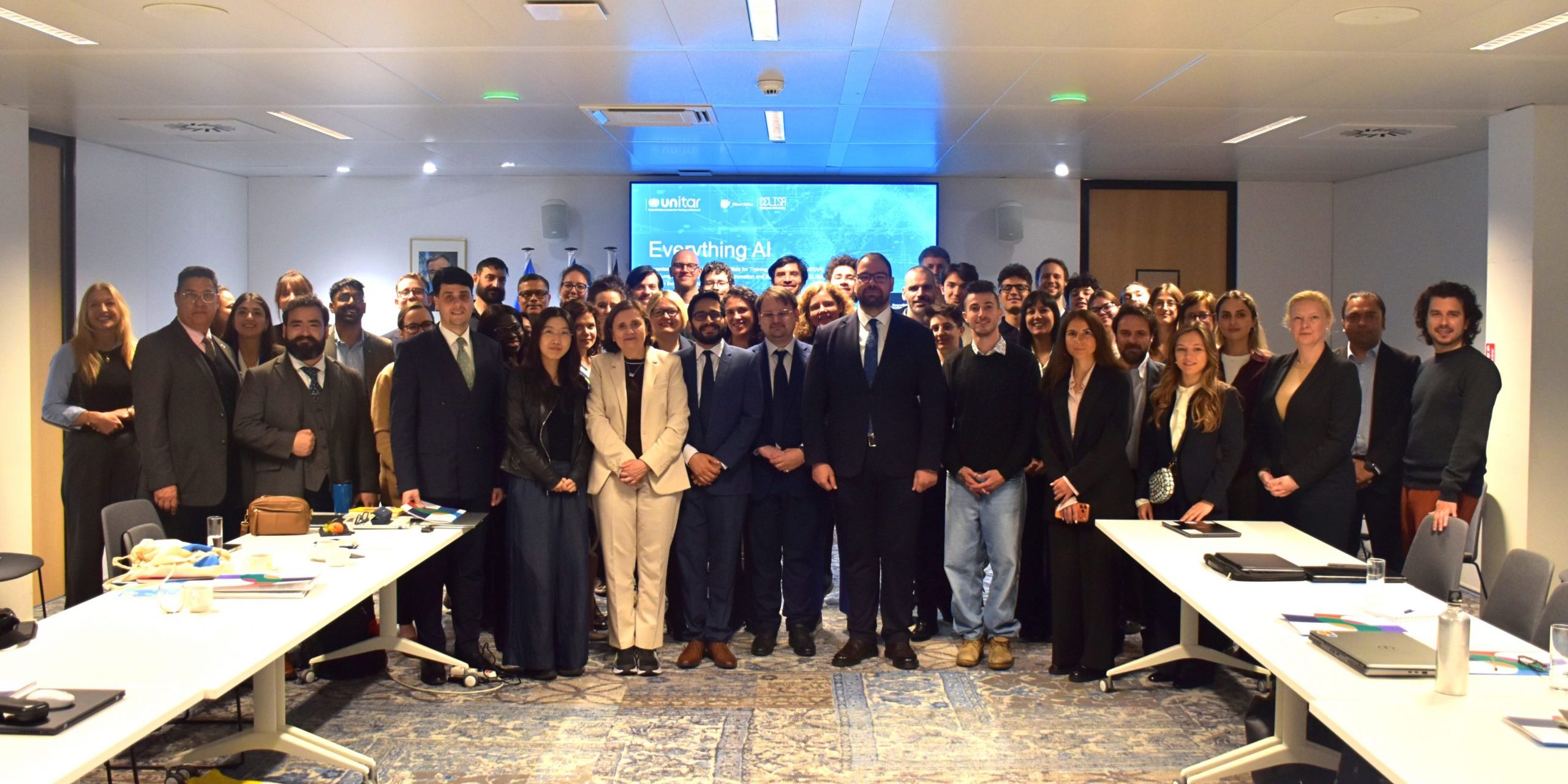
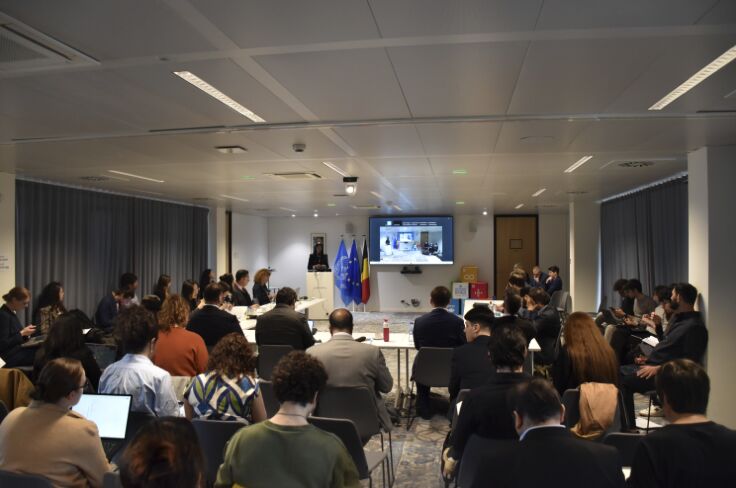
In May 2026, at the UN House in Brussels, engineers, policymakers, legal scholars, and researchers from more than a dozen countries gathered for two days revolving around Everything AI. The third edition of Ethos+Tekhnè, held in partnership with UNITAR and supported by EELISA as a beneficiary of the 7th EELISA Joint Call, was built on the conviction that AI can no longer be contained within a single sector or discipline.
We spoke with Marybelle Cherfan, PhD Candidate at Scuola Superiore Sant’Anna and Program Coordinator of the initiative, to know more about this event.
- Ethos+Tekhné is now in its third edition. For someone who doesn’t know it yet, how would you describe what it is?
Ethos+Tekhné is a meeting point between the worlds of meaning and making. It starts from a simple idea: technology is never only technical. It carries layers of choices, assumptions, risks, values and visions of society.
Ethos+Tekhné was founded by Dr Stefano Vrizzi, whose original intuition was to create a space where technology could be discussed not only as a matter of innovation, but also as a matter of responsibility. The name captures that spirit beautifully. “Ethos” speaks to values, public interest and human impact.
“Tekhné” brings us back to practice, expertise and implementation. Ultimately, Ethos+Tekhné lives in the space between the two: where principles and governance meet practice and design, and where big questions are tested against real institutional and social realities.
2. The theme for this edition was Everything AI. Where did that framing come from and what makes it important?
The framing of “Everything AI” came from the recognition that AI has entered almost every sector, from public administration to education, humanitarian action, elections, migration, disaster risk management, finance, security and beyond. And of course, the list does not end there.
3. What does it take to put something like this together: co-organising between an EELISA community, UNITAR, and speakers from more than a dozen countries?
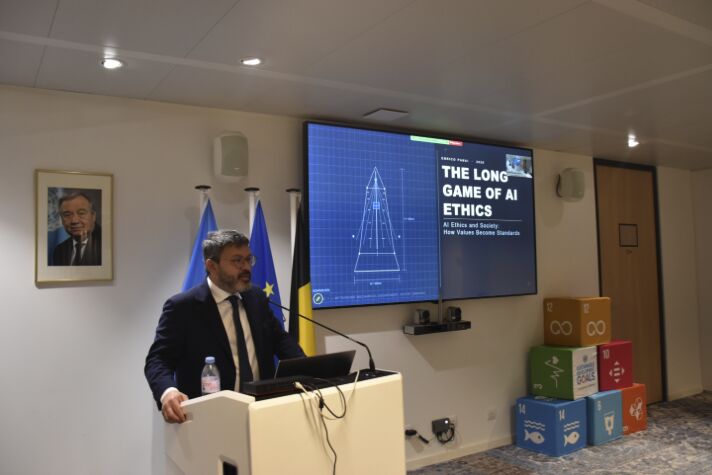
A traditional event often gives you depth within one field, which is important, but AI governance needs more than disciplinary depth. It needs translation between those who design systems, those who regulate them, those who study their social and political effects, and those who have to implement or live with the consequences.
What stayed with me most were the conversations around the sessions. The small exchanges during breaks, the questions that continued after a panel, the moments where someone from a completely different field suddenly recognised the same concern in different words. For me, that was the strongest part of Everything AI: seeing people arrive with different languages and slowly realise they were not in separate conversations after all.
EELISA ought to be part of this conversation because AI governance is not only a regulatory or technical question; it is also an educational one. Universities are training the people who will design, regulate, study, challenge, deploy and live with these systems. So, if we care about accountability and societal impact, universities cannot remain at the edge of the conversation. Their role is not necessarily to have all the answers, but to help ensure that the right questions are asked early enough.
7. What’s the next step for Ethos+Tekhné as a community?
From my side, I would say: keep the room open. So, whether the next step is another event, collaborative outputs, or a renewed partnership with UNITAR, I hope Ethos+Tekhné continues to do what it does best: create the kind of room where difficult questions can be asked.
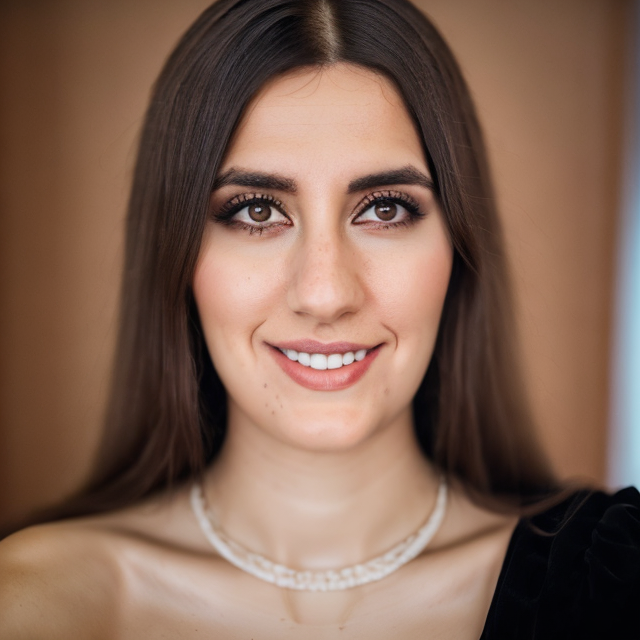
Marybelle Cherfan is a PhD Candidate at Scuola Superiore Sant’Anna, where she also serves as Program Coordinator for a programme delivered in cooperation with the United Nations Institute for Training and Research. Her work focuses on rights-based AI governance, human rights, and the responsible development and deployment of AI systems. She is actively involved in AI standardisation through ISO and CEN-CENELEC JTC 21/WG4 on foundational and societal aspects of artificial intelligence, where she contributes through the Italian delegation and serves as co-editor of the Technical Report on fundamental rights safeguards for trustworthy AI. She also chairs the Standards Working Group of the Association of AI Ethicists and is a Frontier Explorer member of the AI for Developing Countries Forum, with a focus on the role of developing and underrepresented jurisdictions in shaping global AI governance. Outside her work, she hosts a podcast on AI, ethics, and society.