
This past year, EELISA launched its first-ever PhD Mentorship Programme, organized by the Alliance’s Gender and Diversity Working Group. Mentors and mentees from across EELISA were keen to participate in this inaugural edition, which will soon come to a close this November at Université PSL.
Throughout the program, which aims to support those who are particularly marginalized in the academic and doctoral spheres, mentors and mentees participated in virtual training sessions and one-on-one meetings to discuss potential career paths, best practices in research and more.
Ahead of the closing event, which includes a final group training session and a round table on the importance of mentorship in academia, we spoke to Waradon Phokhinanan, a PhD student in neuroscience at the Ecole normale supérieure – PSL. In this EELISA Narrators article, Waradon discusses his motivations in joining the mentorship program and the insight he gained from his mentor.
What motivated you to join the EELISA PhD Mentorship Program?
My main motivation was that I feel I belong to almost every minority group imaginable in academia, while trying to pursue what I love, which is research. Academia has a strong culture of performance and productivity, alongside professional and social expectations, and everyone is expected to perform consistently regardless of their individual circumstances. I sometimes find these expectations overwhelming, especially when thinking about the uncertainty of my future career path. Although many opportunities are, in principle, open to everyone, it does not always feel that simple.
I hoped this programme would give me the chance to meet mentors and peers from diverse backgrounds, learn about the challenges they have faced, and understand how they found their own paths. For me, the key was realising that there may be many different ways to belong in research. I also hoped to gain new perspectives, build my confidence and skills through training, and find a safe space to share experiences with others.
How did you and your mentor work together and communicate during the program?
I joined the programme during a particularly busy period of my final PhD year, with thesis writing and a research exchange happening at the same time. I did not have much time for frequent or in-depth discussions. However, my mentor was very kind and happy to offer support whenever needed. In practice, we met online roughly once every month and a half, keeping our communication quite flexible. Our discussions mainly focused on career development and opportunities in academia, particularly the challenges and possibilities of pursuing a research career in Europe as a foreign researcher.
What were the highlights of your experience as a mentee?
It broadened my perspective more than I expected. I found my mentor’s story encouraging, especially hearing about the challenges they faced and how they navigated them. It was a real example of an alternative path towards an academic career, and it made me realise there may be opportunities I had never even considered. My mentor also has experience outside academia, which was particularly useful for comparing different research environments and career o
ptions. I thought mentorship might help me find a clearer path, but perhaps the biggest highlight was realising that there is more than one path to where I want to be.
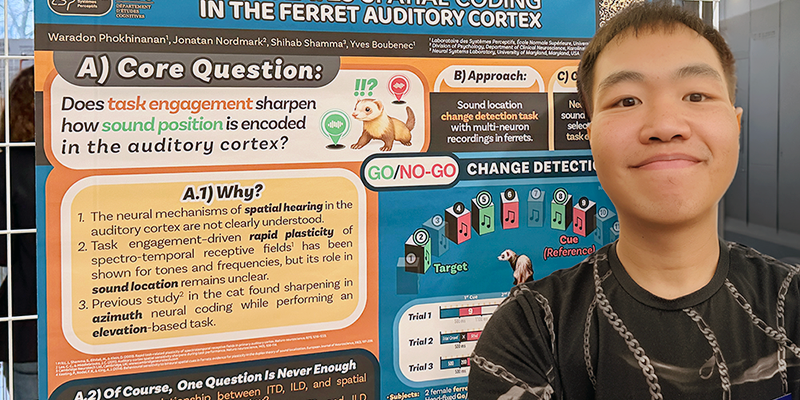
Waradon Phokhinanan
Is currently in the final year of his PhD in Systems Neuroscience (Electrophysiology) at ENS-PSL, Paris.
His core expertise lies in spatial hearing, understanding how we listen in real-world environments using two ears, how we localize sound, and what information is encoded in the brain during this process. This includes investigating how neural modulation from other brain regions, such as those involved in auditory attention and memory, influences spatial hearing in both humans and machines. His goal is to use this understanding and inspiration from biological systems to build machines that listen more like humans and, ultimately, to help address hearing loss.