
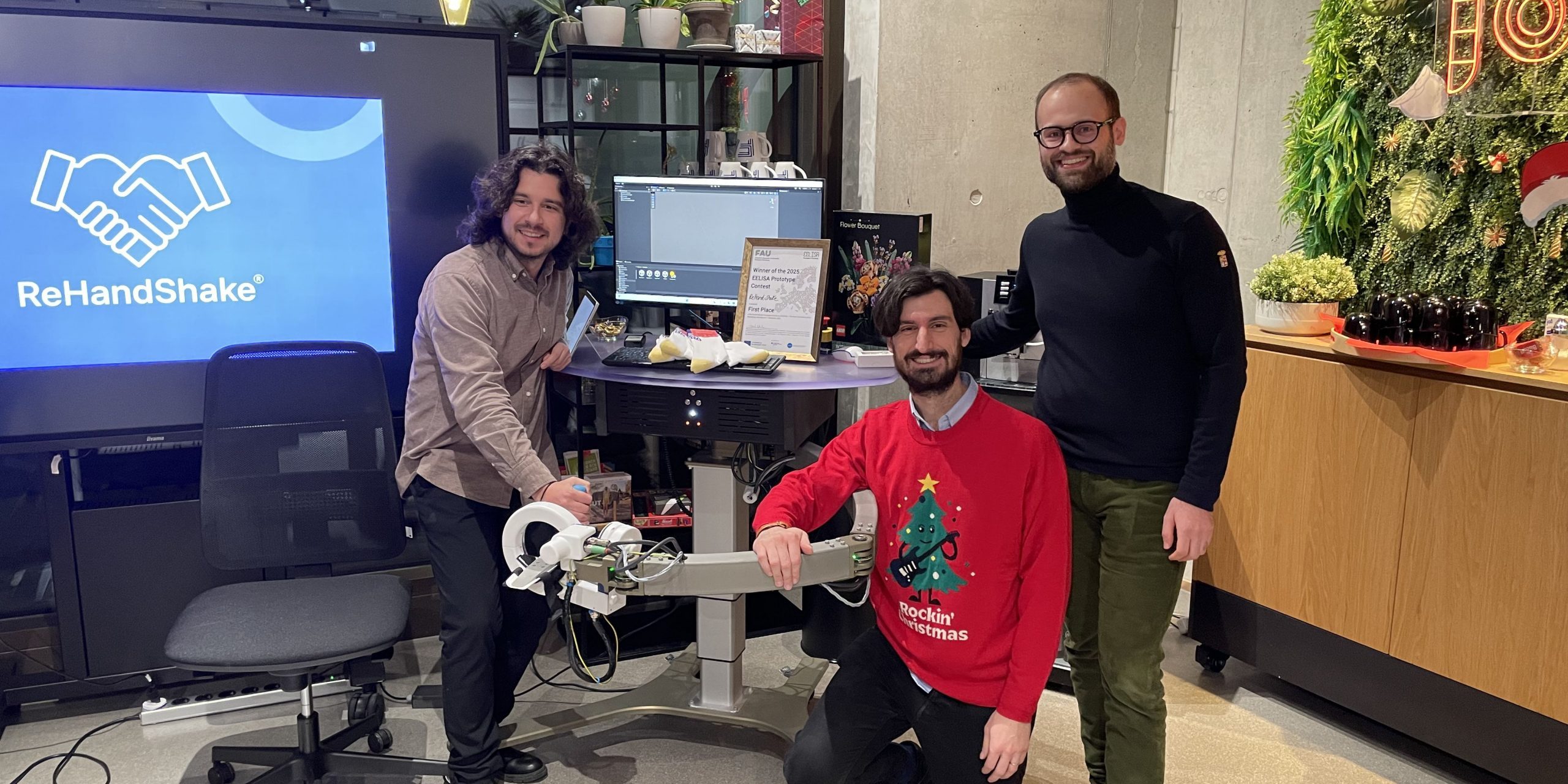
Last December, emerging startup teams from across EELISA partner universities took part in the 4th EELISA Prototype Contest, hosted by FAU in cooperation with JOSEPHS – The Open Innovation Lab in Nuremberg, Germany. The participating teams included Beauty Twin (FAU/UPM), Capio Robotics (SSSA), Forest Guard (UPB), ReHand Shake (SSSA), and Wisdex (FAU). During a four-day onsite co-creation workshop at JOSEPHS, the teams explored open innovation methods, learning to better understand users and customers, further develop and validate their prototypes, and build market-ready innovations. On the final day, the startups presented their prototypes at JOSEPHS’ open test space, inviting visitors to explore, test, and provide feedback. The event concluded with a final pitch competition, where all teams presented their prototypes to a jury of experts and the audience. The winner of the 4th edition of the EELISA Prototype Contest 2025 was ReHand Shake, a robotic solution for wrist rehabilitation. The organizer of the event, David Schkade, had the opportunity to interview the winning team behind ReHand Shake, Cristian Camardella, Alessandro Genua and Anastasios Tzepkenlis from Scuola Superiore Sant’Anna, about their innovation journey with ReHand Shake and the EELISA Prototype Contest 2025.
Q. Dear Cristian, Alessandro and Anastasios, first and foremost, congratulations on winning the EELISA Prototype Contest 2025 with your prototype, ReHand Shake! Could you tell our readers what your prototype is all about and share the story behind it?
A. Cristian: ReHand Shake is a wrist exoskeleton platform developed by our team, under the supervision of Professor Antonio Frisoli, at the Institute of Mechanical Intelligence of Scuola Superiore Sant’Anna in Pisa. It was originally conceived as an orthopedic rehabilitation for workers with wrist injuries, but through continuous improvements and refinements it has evolved into a versatile system capable of supporting a wide range of users who require wrist rehabilitation and assistance.
Q. What motivated you to participate in the EELISA Prototype Contest, which included not only the contest, but also a three-day open innovation methods workshop and a public test space for your prototype at JOSEPHS?
A. Alessandro: We were motivated to participate in the EELISA Prototype Contest, because we wanted to showcase the potential of robotics and human-robot interaction to enhance human well-being and improve the daily lives of people in need. Moreover, knowing that the event was organized by FAU and hosted at JOSEPHS, we could not miss the opportunity to present our prototype in such a renowned German innovation environment.
Q. What were the most important things you learnt from the workshop on open innovation methods? A. Anastasios: I learned that research and innovation are often confused, yet they are fundamentally different. Being trained by professionals and interacting with people from diverse backgrounds helped me realize that an idea that seems perfect in my mind may not necessarily fit real market needs. Alessandro: The most important lesson for me was understanding the value of communicating directly with end users and truly listening to how they perceive our idea. Stepping out of my comfort zone and explaining our work to people outside the research community was a major learning experience, and I am very grateful for it.
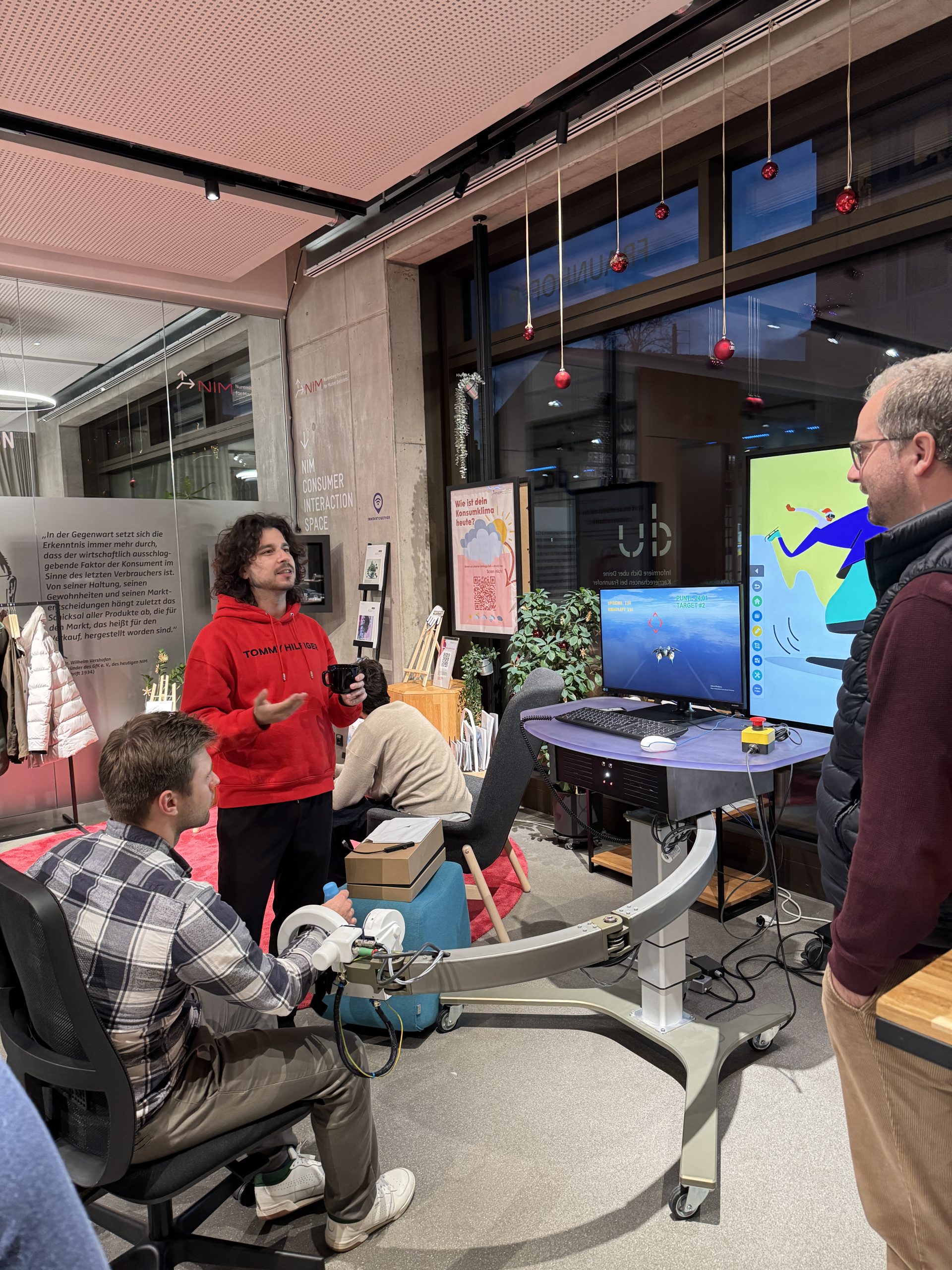
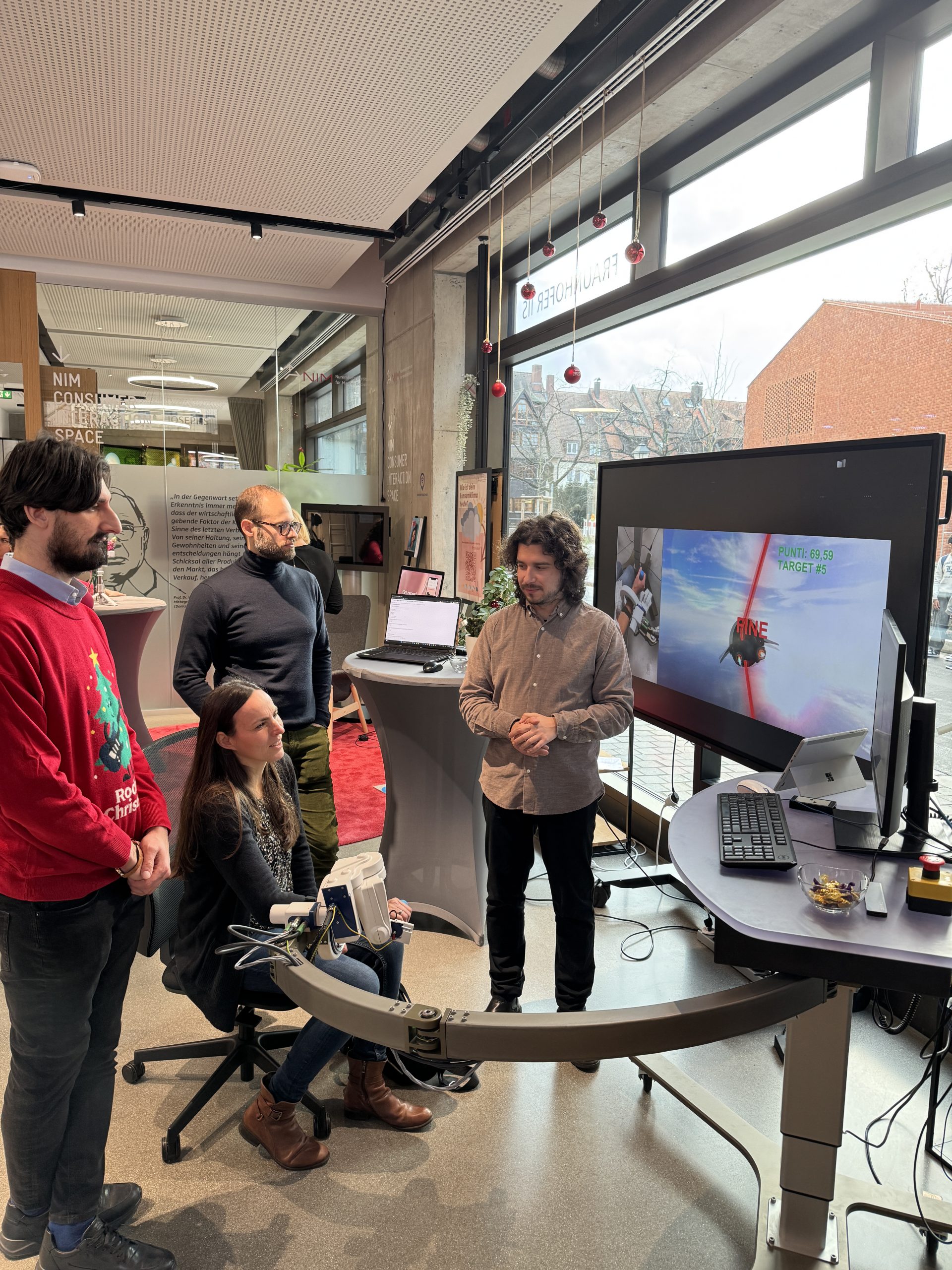
Q. On the last day of the event, you had the opportunity to set up a public test space for your prototype, where you got actual user feedback. What was your experience with your test space and which insights did you get? Was there something that was particularly important or surprising for you? A. Cristian: Although I have extensive experience attending conferences and exhibitions worldwide, I was not prepared for how different it feels when an exhibition space is directly connected to everyday people. Instead of focusing on mechatronics, control logic, or software details, visitors were primarily interested in the purpose and impact of the product. They validated its relevance and expressed genuine hope that it could one day become a real, everyday solution for those who need it, rather than remaining just a prototype. Anastasios: For me personally, seeing people walk into the JOSEPHS open innovation lab and test our prototype firsthand was an unforgettable experience. Receiving real-time feedback and concrete suggestions made the entire experience incredibly rewarding and meaningful.
Q. Finally, we are curious: What are the next steps on your innovation journey with ReHand Shake? A. Cristian: We are currently developing new control strategies to further enhance rehabilitation performance. For example, we have already implemented a simulation of liquid pouring that gives users the sensation of fluid movement inside a virtual bottle. This allows them to practice daily activities such as filling a cup of coffee or pouring a beer, making the system more engaging and attractive for real-world applications. Alessandro: My focus is on understanding how wrist-exoskeleton misalignment can affect rehabilitation outcomes and how to mitigate these effects through advanced kinematic modeling and machine learning techniques. Anastasios: In parallel, we are working on improving the overall system by expanding its range of use cases. Within this framework, I am developing the AI components of the platform to make it smarter, more adaptive, and more effective. After all, AI really is the magic word, isn’t it?
Q. Dear Cristian, Alessandro and Anastasios, it has been a pleasure and I wish you all the best for the future! A. All: Thank you very much for giving us the opportunity to participate and to showcase our prototype. We truly hope that ReHand Shake will one day reach the market and benefit many people in need. Grazie mille and arrivederci!
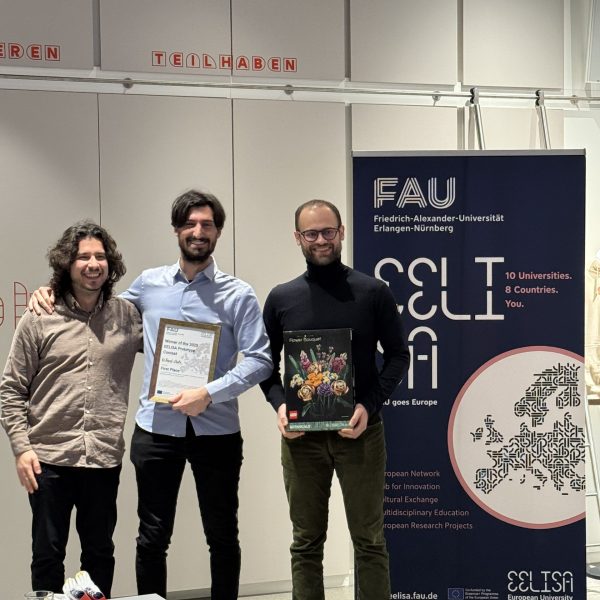
ReHandShake Team Cristian Camardella He is a researcher at the Sant’Anna institute of Mechannical Intelligence