
How Tech2Market turned three research ideas into startups and sent their founders to Europe’s biggest innovation fair.
Between February and May 2026, around 25 researchers from BME, FAU, ITU, PSL, SSSA and Politehnica Bucharest took part in the EELISA Tech2Market programme: a series of weekly online workshops, led by experts from UPM, BME, ZHAW and FAU, designed to help them understand the business potential of their work. The goal: turn strong research into a viable, market-ready case within 12 to 24 months.
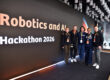
The programme closed with a live demo day in Madrid where three teams walked away with tickets to VivaTech 2026, Europe’s largest startup and innovation fair, drawing nearly 200,000 industry leaders, entrepreneurs, researchers andstudents.
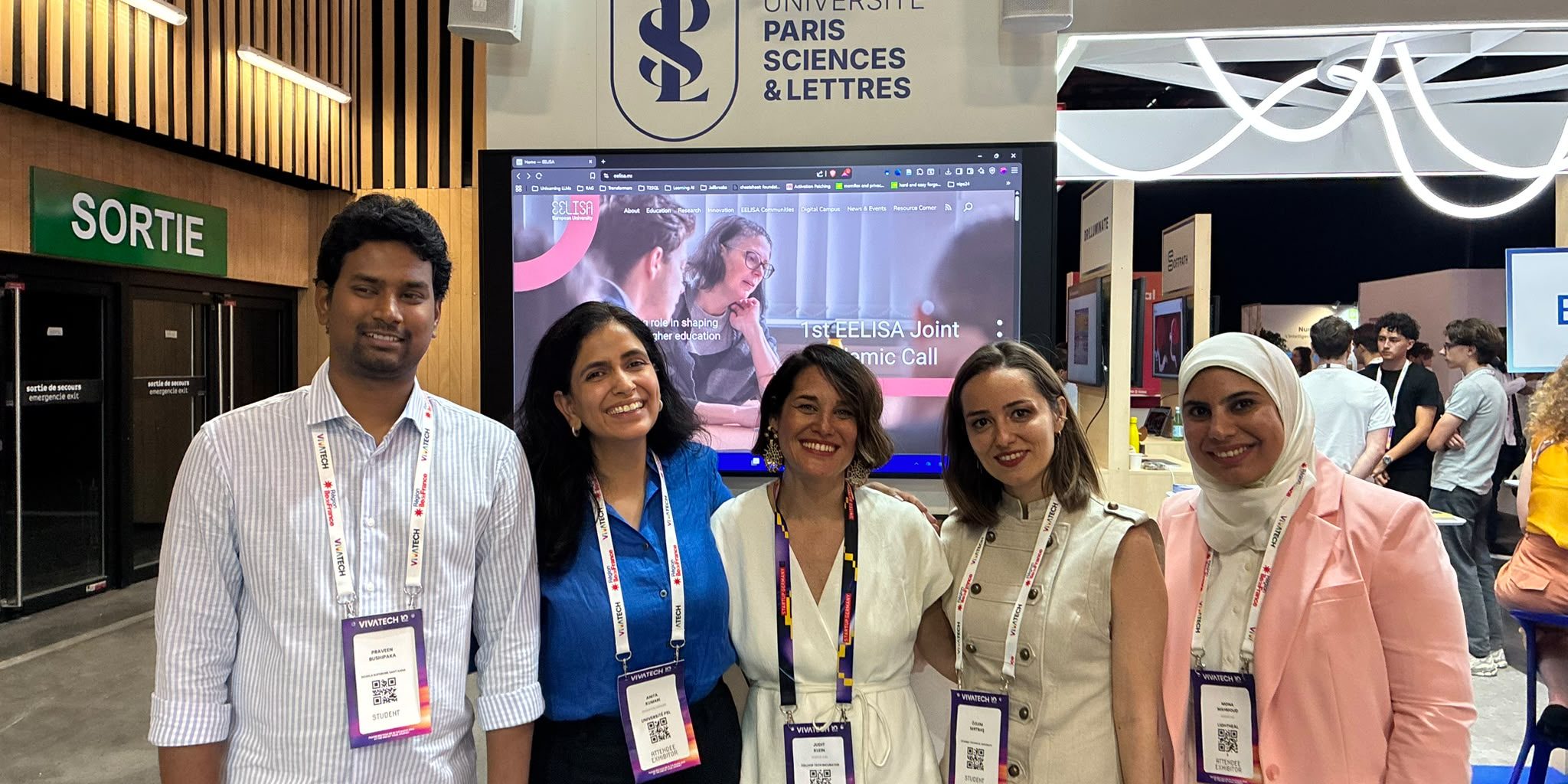
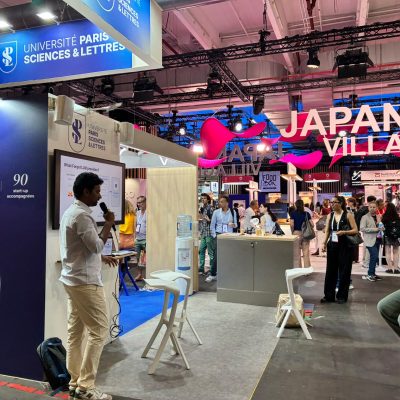
Pitching from Université PSL’s stand, spanning AI, computing, health, energy and green tech were:
– Praveen Bushipaka (SSSA & UNIPI), whose project ForgetLLM helps organisations make their AI models comply with privacy and data-removal regulations.
– Özlem Sertbaş (ITU), whose platform K-NOW gives real estate developers AI-powered feasibility analysis.
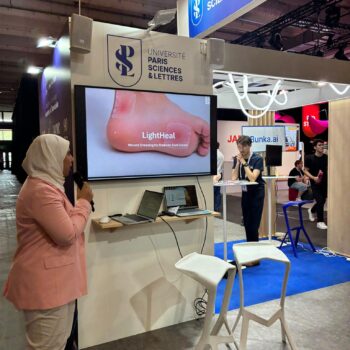
– Mona Mahmoud (FAU), who is developing a photodynamic technique called LightHeal to treat chronic wounds.
Learning to think like a customer, not only a researcher
Ask any of the three what Tech2Market changed, and even when they work with different ideas, the answer converges fast.
For Mona, from LightHeal, who was presenting at an entrepreneurship event for the first time it was clear the need to go beyond a tech mindset:
“I understood that I have to think from the customer’s side and not just about the technology. How to structure a five-minute clear pitch was also very challenging for me as someone from an academic background.”
For Praveen, whose team built ForgetLLM to help organisations comply with data-removal and privacy regulations, the shift was about validating the problem before the solution:
“The programme encouraged us to validate the problem, understand customer needs, and consider product-market fit, things that are rarely part of a traditional research journey but are essential for turning research into innovation.”
Özlem Sertbaş, from ITU and whose platform K-NOW grew directly out of her own academic research, describes the same reorientation towards the ideation of her project:
“The most valuable lesson was learning how to translate a technically strong idea into a clear value proposition centred on an actual customer problem. The programme encouraged me to look beyond the technology itself and focus more closely on customer validation, market positioning, and building a realistic path towards commercialisation.”
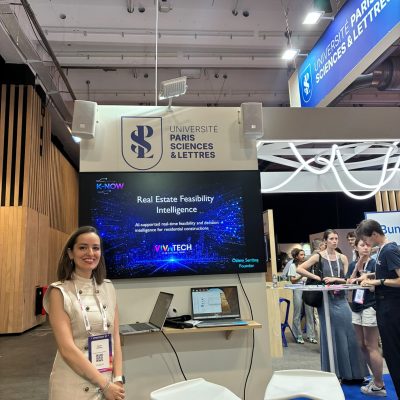
Experiencing Vivatech 2026
With the opportunity to participate at Vivatech, each of them found a different kind of validation for their work.
For all three researchers, it was the people and the exchange of ideas:
For Mona, “After my pitch, I had a really interesting conversation with a business man from Canada, who gave me great advice: not only to search for business partners but also to go for big names in the medical field of chronic wounds to validate my idea and get credibility through their participation.”
And for Praveen, there was a hard question in which a visitor asked him whether a Big Tech company could simply replicate ForgetLLM’s work: “this was a realistic question, given the aggressive product acquisition and replication nature of Big Tech. Not a comfortable moment, but a useful one, being a reminder of exactly what a young startup is up against”, he explains.
Université PSL’s stand also hosted a talk co-led by PSL’s Anita Kumari and ZOLLHOF Tech Incubator’s Judit Klein on “Building Bridges: Scaling Deep Tech Innovation in Europe with the European University EELISA.
The EELISA Impact
Beyond the pitch itself, the three participants point to something less tangible: how the EELISA ecosystem reshaped the way they think about their own research.
“What has really changed through my innovation journey is that I now think more about the impact of my research, or how my knowledge can actually give something back to society,” Mona reflects.
Praveen and his team came to a similar place from a different angle, with the realization their research had a life beyond publication: “Before joining EELISA, our work was focused primarily on research and experimental results. We had not really considered whether it could become a viable product. It helped us bridge the gap between academic research and practical application and gave us confidence that our work has potential beyond publications.”
Özlem describes the shift as one of resilience and strategy: “It taught me how to handle critical or negative feedback constructively, without losing confidence in the project. EELISA therefore shaped not only the development of the project, but also my own growth as an entrepreneur.”
Where they go from here
None of the three consider VivaTech a finish line.
Mona’s LightHeal is waiting on funding approval from the German Academic Exchange Service to build their first prototype, which she hopes to develop further at the EELISA Prototype Contest in December 2026, before pitching investors at EELISA Next Level in spring 2027.
Özlem’s K-NOW is progressing through Turkey’s TÜBİTAK BİGG programme, with plans to formally establish the company in October 2026 and begin proof-of-concept development soon after, starting with pilots in Türkiye before expanding to European markets.
Praveen’s team is focused on completing their platform for first launch, engaging early customers to validate the solution, and exploring funding and partnerships to scale ForgetLLM to a broader range of organisations.
Three different fields, three different next steps, all developing within EELISA’s ecosystem.
EELISA Innovation Pathway
Also a researcher thinking about turning your work into a business case? EELISA offers several ways in:
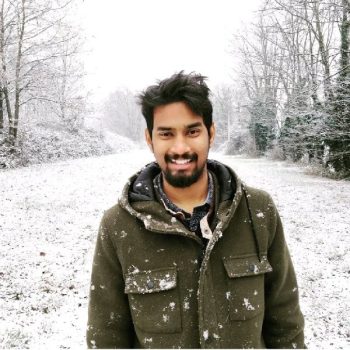
Özlem Sertbaş
She is an architect, researcher, and the founder of K‑NOW. She recently completed her second master’s degree at Istanbul Technical University, where her research focused on developing an event-driven and AI-supported decision-making framework for real estate feasibility. She has also been accepted into the PhD Programme in Project and Construction Management at ITU and will begin her doctoral studies in the upcoming academic term. At K‑NOW, she leads product vision, research, business development, and the transformation of academic knowledge into a practical technology solution.

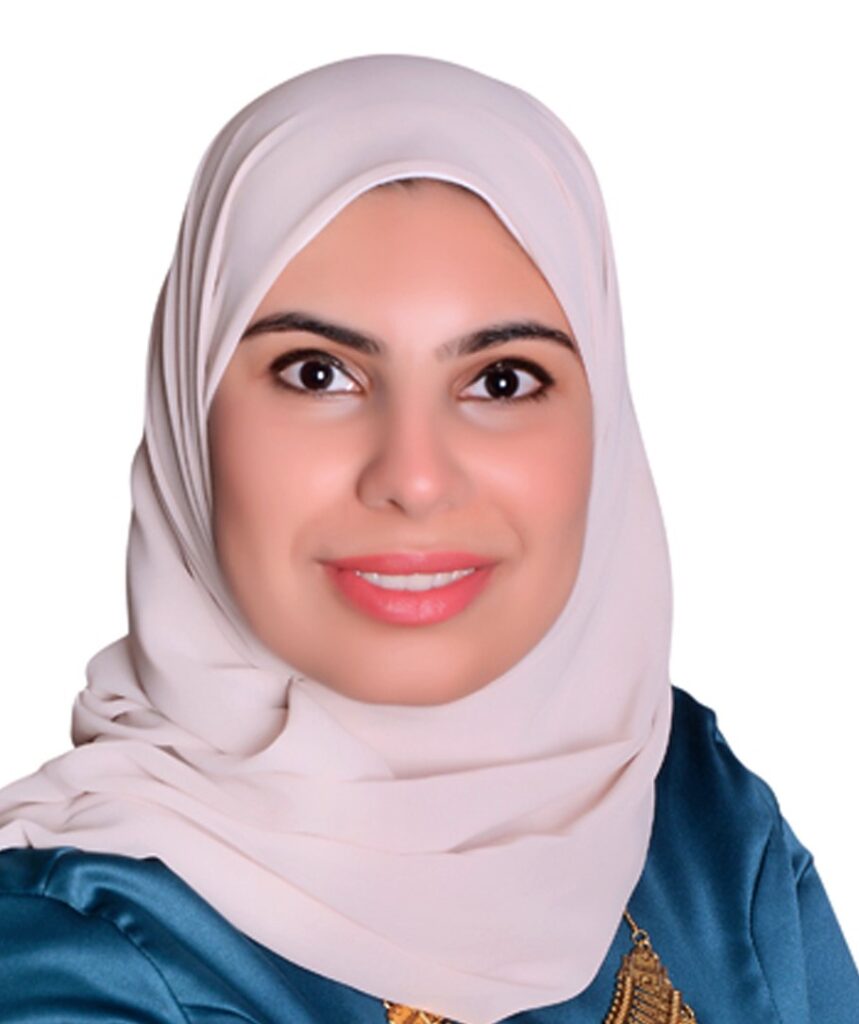
Mona Mahmoud
She is a microbiologist who recently finished her postdoctoral program at the Biology Department of Friedrich-Alexander-Universität Erlangen-Nürnberg (FAU). Having worked on the topic in her doctoral studies and postdoctoral work, her goal is now to develop a wound dressing based on a light-activated antimicrobial approach “photodynamic inactivation” to reduce harmful bacteria in chronic wounds and support wound healing.